



Elon Musk’s Lunar City Dream and Bediüzzaman’s Century-Old Truth: A Striking Intersection
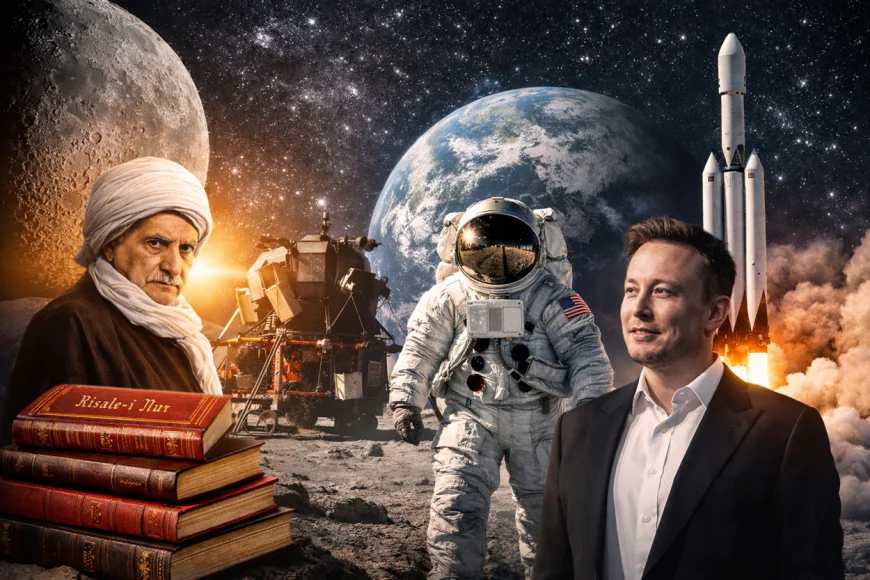
As Elon Musk plans a self-sustaining city on the Moon within a decade, a century-old metaphysical warning from Bediüzzaman Said Nursi about the "lifeless and dark" nature of the Moon resurfaces.


Journalist | Political & Strategic Analyst
Elon Musk’s Dream of a Lunar City and Bediüzzaman’s Century-Old Truth: A Striking Intersection of Science and Metaphysics
The history of humanity has been shaped by a curiosity for the unknown. From ancient philosophers questioning what lies in the sky to modern engineers piercing the atmosphere with rockets, this quest has never ceased. However, today, a surprising bridge is being built between the recent statements of the 21st century’s greatest technology visionary, Elon Musk, and the lines penned by Bediüzzaman Said Nursi in a humble room in Barla, Isparta, at the beginning of the 20th century.
Elon Musk’s goal of "establishing a self-sustaining city on the Moon within 10 years" is not merely a technological challenge; it is also humanity’s search for life on a celestial body that is "dense and dark" (kesafetli ve zulümatlı). Is science and technology rushing toward that "desolate loneliness" against which Said Nursi warned in his Risale-i Nur collection (The Words) by saying, "Your effort is in vain," or is humanity seeking the "sun of truth" on other planets? Here is an in-depth analysis of Elon Musk’s new route and the century-old foresights of the Risale-i Nur.
Part 1: The Return from Mars to the Moon – Musk’s New Strategy
The world's richest man and founder of SpaceX, Elon Musk, had for years designated the Red Planet, Mars, as his target, arguing that humanity must become a "multi-planetary species." However, recent statements made via the Wall Street Journal and Musk’s own platform, X, indicate a strategic axis shift. Musk has announced that the priority is no longer Mars, but the Moon.


In Musk’s words: "The highest priority is to secure the future of civilization. Access to the Moon is faster." This statement aligns with the plan presented to SpaceX investors: an unmanned flight to the Moon in 2027 and the establishment of a "self-growing lunar city" within 10 years.
This change in strategy is not just a logistical preference. The transformation of SpaceX into a trillion-dollar ecosystem by merging with the AI initiative xAI, and Tesla's commencement of "Optimus" humanoid robot production, signal that the city to be established on the Moon will be built more by autonomous systems than by human labor. Musk codes the Moon not as a stepping stone, but as a new habitat. However, this "habitat" is, by its nature, a dead celestial body. It is at this precise point that the fine line between scientific data and Said Nursi's metaphysical determination becomes distinct.
Part 2: The Reality of the "Moon" (Kamer) from the Perspective of Risale-i Nur
In the 1910s, when mankind could not even dream of going beyond the atmosphere, Bediüzzaman Said Nursi described the human effort to discover the universe through knowledge in an allegorical language in his work titled The Words (specifically in the 24th Word, the treatise on the Drop). Nursi likens the "sage philosopher" (hakîm feylesof), who takes science (philosophy) as a guide and seeks truth disconnected from revelation, to a drop of water (Katre) and takes him on an imaginary journey.


The following expressions in the text are like a spiritual X-ray of the physical reality that NASA and Musk face today:
"Now, you too, O sage philosopher who has entered the Drop! With the telescope of your drop-like thought and the ladder of philosophy, you have advanced as far as the moon and entered it. Look, the moon is in itself dense and dark. It has neither light nor life. Your effort has been in vain, your knowledge has gone to waste."
Here, Said Nursi draws attention to three fundamental physical characteristics of the Moon (Kamer):
-
Kesafetli (Dense): Meaning solid, rigid, a mass of matter.
-
Zulümatlı (Dark): Possessing no light of its own, gloomy.
-
Hayatsız (Lifeless): Harboring no life within.
The city Elon Musk wants to build is situated on these very soils that have "neither light nor life." What Nursi defined as the "ladder of philosophy" corresponds today to SpaceX's massive rockets, and the "telescope of thought" to the telescopes of modern astronomy. Nursi emphasizes that this technological and intellectual advancement (terakki), if devoid of a spiritual foundation, will lead man only to a "terrible loneliness" and the "savagery of isolation."
Part 3: NASA, Apollo 11, and the Debate on the "Futility of Knowledge"
When Apollo 11 landed on the lunar surface in 1969, the landscape Neil Armstrong and Buzz Aldrin encountered was exactly the same as the one Bediüzzaman had described approximately 56 years earlier: A dead earth shining under a gray, silent, windless, lifeless, and pitch-black sky.
Although conspiracy theorists have maintained for years that "NASA did not go to the Moon" or asked, "Did NASA get this information from ancient books?", there is a scientific reality at hand. Said Nursi's determination is more than a prophecy; it is a sagacity (feraset) brought about by looking at the universe through the light of the Qur'an. The fact that the Moon is a "mirror" reflecting light from the Sun does not change the truth that it is dark in its own essence.
Today, Elon Musk views going to the Moon as "saving civilization." However, the text in the Risale-i Nur warns that this departure could turn into the "darkness of despair." The deep psychological voids experienced by astronauts returning from the Moon, and the existential shock known as the "Overview Effect" caused by seeing the Earth from afar, coincide with the concept of the "terror of desolation" (vahşetin dehşeti) mentioned by Nursi. There, in those dark craters, there is no atmosphere (mercy) to protect man, nor a life to warm him.
Part 4: The City to be Built in 10 Years and the "Night of Nature"
According to Musk's plan, a city will be established on the Moon within 10 years. This city will be a structure that grows on its own without any support from the outside. Tesla's robots will mine, and 3D printers will construct buildings. However, the solution proposed in Bediüzzaman's text points to much more than technological colonization; it points to an ontological salvation:
"You can be saved from the darkness of despair and the desolation of loneliness... on these conditions: That you abandon the night of nature and turn towards the sun of truth, and believe with certainty that these night lights are but shadows of the lights of the daytime sun."
Here, the "night of nature" is not just the dark side of the Moon, but also the materialist worldview. Musk and modern science seek salvation by removing humanity from Earth (the night of nature) and physically transporting it to another celestial body. Risale-i Nur, on the other hand, argues that salvation lies not in changing location, but in changing perspective (nazar).
Will the people living in a city on the Moon be able to escape the "savagery of isolation," even if they technically survive? The spiritual pressure of living under radiation shields, breathing artificial air, and staring into a black sky may correspond to the situation defined by Said Nursi as the "annoyance of evil spirits" (ervâh-ı habisenin iz’âcâtı).
Part 5: Strategic and Economic Analysis – A Trillion-Dollar "Vain" Effort?
According to reports, SpaceX's value is approaching $1 trillion. Tesla is investing $20 billion in humanoid robots. This massive economic power is being used to build the "ladder of philosophy" even higher.
-
Economic Risks: Building a city on the Moon is the most expensive real estate project in history. Musk is taking a risk large enough to halt Tesla's production lines to switch to robot production.
-
Scientific Challenge: Lunar dust (regolith) is razor-sharp, there is no atmosphere, and temperatures swing between -173°C and +127°C. This environment, which Said Nursi called "lifeless," rejects biological existence.
-
Metaphysical Interpretation: If this effort is undertaken with a motivation based solely on fear, such as "backing up civilization," it may remain a "vain effort" (sa’y beyhude) in Nursi's terms. Because wherever man goes, he will carry his inner spiritual void and the reality of death with him.
Conclusion: The Journey of the Drop Continues
Elon Musk's vision of establishing a city on the Moon within 10 years is one of the most audacious steps in human history. However, this step is not independent of the map drawn by Said Nursi in The Words approximately 113 years ago.
Science (the Drop) has leaned its ladders and climbed to the Moon (Kamer). It has seen for itself that the place is dense, dark, and dead. Now, it is trying to carry life to that dead soil.
This timeless dialogue between Said Nursi and Elon Musk shows us this: Even if humanity reaches the stars with its technology, it is in need of the "Sun of Truth" for the peace of its soul. A city to be built on the Moon may be an engineering marvel; but its inhabitants, when looking out their windows into the pitch-black void of space, will have to hold on to meaning beyond matter to avoid feeling the "terror of desolation" mentioned by Bediüzzaman.
NASA's and Musk's data have validated Said Nursi: The Moon is dead in its own essence. What will carry life there is not just rockets, but that "spiritual light" in man's view of the universe. Otherwise, whether Mars or the Moon, humanity will merely have transported its loneliness further away.
Yusuf İnan
Yusuf İnan is a journalist and author. He serves as Editor-in-Chief of WiseNewsPress.com, SehitlerOlmez.com, and YerelGundem.com, and specializes in strategic and political analysis of Turkish and global affairs.
What's Your Reaction?
 Like
0
Like
0
 Dislike
0
Dislike
0
 Love
0
Love
0
 Funny
0
Funny
0
 Wow
0
Wow
0
 Sad
0
Sad
0
 Angry
0
Angry
0

Editor | Wise News Press — Delivering accurate, timely global news with integrity, insight, and editorial responsibility.


















Comments (0)